PROLIGION
The term PROLIGION supersedes RELIGION in
that it intends to unite "the good and the godly," people of
character with a good conscience, good persons that is, regardless of their
religious belief system, to work for the betterment of our human race, our
societies, and our world.
What is the definition of a “good person”?
Below is a generalized summary description at the top of what we find when we
do a Copilot Search, but the Search goes into much greater detail:
“A good person is someone who consistently
acts with empathy, integrity, compassion, and moral consideration, striving to
promote well-being and avoid harm to others.”
Ercian Philosophy through the concept of
Proligion wants to leave what a good person is UNDEFINED and up to God, a
Judging God, the Living God, and then instructs each person to seek that ideal,
to try to be a good person the best way they can.
In an effort to unite “the good and the
godly,”
PROLIGION tries to overcome the differences among Western religions
(Judaism, Christianity, and Islam) by confessing our collective ignorance about
the nature of the God we have never seen or met in person and by agreeing to
accept a concept of the Living God that we can all share in common and towards
whom we can direct our Faith.
The main differences between the Ercian
religion and the other Western religions are as follows:
1) Eternity
is the quality or factor that determines what the Infinite Source and Ultimate
God is, and no creator being with a mind system can possess such quality or
factor.
2) Therefore,
no religion possesses “The Word of God,” the “Ultimate” and Eternal God, that
is.
3) Any
living conscious God possessing a mind system that we may pray to or have faith
in, is a creature or being evolved from the primary Ultimate God, and
therefore, whose “word” is to be considered or judged like that of any other
creature of the Ultimate God possessing a mind system regarding its truth and
goodness content.
4) Religious
books contain the words of men and, therefore, must not be considered sacred
but treated like any other books subject to inspection and criticism.
5) The
status of women must be equal to that of men in marriage and in society in
general. Women are human and have souls just like men. It is ironic that the
female who has to suffer the burden of carrying another being in her belly for
nine months and then suffer the agony of giving birth in the process of
procreation is the sex considered inferior and a servant to the male sex. Honor
your mothers, your sisters, and your daughters, so I think EllaEl, the Living
God of the Ercian religion would command.
6) No
religion must instruct its followers to kill people who do not believe as they
do.
PROLIGION also seeks to bring into our proligious
union, good persons who have never been religious or that believe in God and
voluntarily want to become part of the faith.
The same as it is with the Ercian
religion, a one-on-one relationship between the free individual and God and no
group worship, no formal church, temple or organization shall be created to
promote proligion. If people become proligious, it will be a natural outcome of
people talking to each other, word of mouth or some form of advertising, but
never a product of coercion or aggressive proselytizing.
The paragraph below summarizes all that
PROLIGION asks of the free individual:
PROLIGION: Have faith
in God, the Living God, a Judging God, the God of Humans. Use "God"
as God's name, since we have not met formally. Worship is for Kings with egos.
Honor God by being a good person, the only commandment. How? Read books. Talk
to people. Use your human brains.
Blessed be the
proligious spirit! And there shall be a new beginning!
In God with Love, in
God with Knowledge, and in God with Courage. Forever and Ever, Amen!
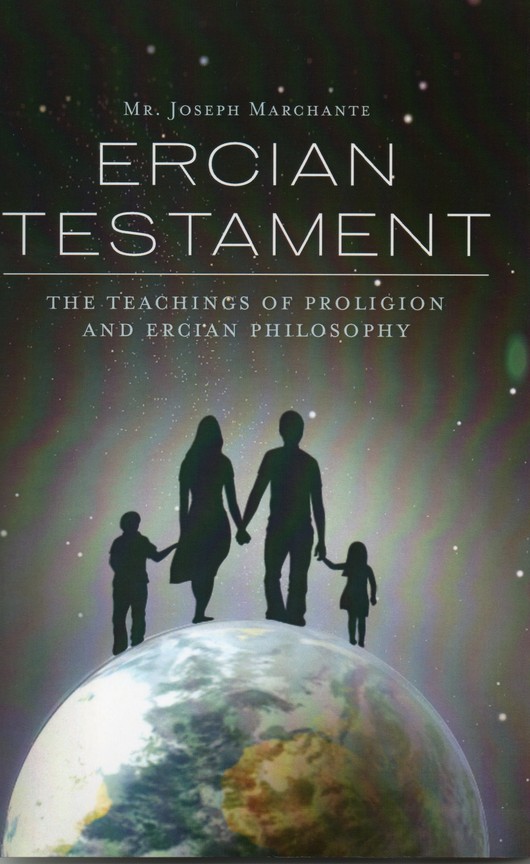
AVAILABLE AT AMAZON.COM: My religion and philosophy are spelled out in the book "Ercian Testament" with the subtitle "The Teachings of Proligion and Ercian Philosophy."
&&&&&&&&&&&&&&&&&&&&&&&&&&&&&&&&&&&&&&&&&&&&&&&&&&&&&&&&&&&&&&&&&&